
by michaelhalassa | Mar 16, 2026 | Cognitive flexibility, Cognitive Processing, Computational neuroscience, Halassa Lab, Michael Halassa, Neural circuits, NeuroAI
https://michaelhalassa.substack.com/p/the-quiet-war-between-abstraction Every time you walk into a new restaurant, your brain solves an invisible problem: Which parts of this experience are specific to this place (the menu, the layout, the staff) and which parts are...
by michaelhalassa | Mar 16, 2026 | Cognitive flexibility, Cognitive Processing, Computational neuroscience, Halassa Lab, Michael Halassa, Neural circuits
How the brain constructs the values that guide everyday decisions reveals one of neuroscience’s most fascinating puzzles. Think about it: your brain adds and subtracts quantities that share no common unit! It can add morning light through kitchen windows to forty...

by michaelhalassa | Jul 17, 2025 | Cognitive flexibility, Cognitive Processing, Computational neuroscience, Halassa Lab, Michael Halassa, Neural circuits, NeuroAI, Neuroscience, Science
A mouse can explore a new environment, find food and adapt when the rules change, all using less energy than a lightbulb. Meanwhile, our most powerful computers can solve chess and master protein folding, but still can’t walk across a messy room without crashing into...

by michaelhalassa | Jul 11, 2025 | Cognitive flexibility, Cognitive Processing, Computational neuroscience, Halassa Lab, Michael Halassa, Neural circuits, Prefrontal cortex, Thalamocortical circuits
An Elegant Natural Experiment The study by Mackenzie et al. (2025, bioRxiv) represents a particularly clever approach to understanding human thalamic function. Rather than relying on correlational neuroimaging, the researchers capitalized on an unintended consequence...
by michaelhalassa | Oct 31, 2024 | Cognitive Processing
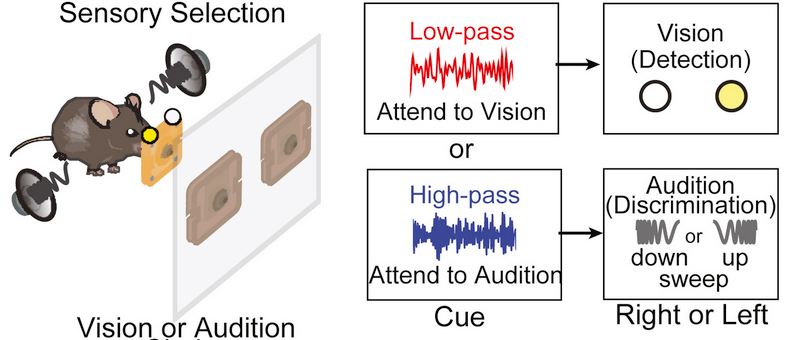
Human Psychophysics: The Foundation Psychophysics, the study of the relationship between physical stimuli and perceptual experiences, has a rich tradition in human research, dating back to pioneers like Gustav Fechner and Ernst Weber. By designing tasks that precisely...